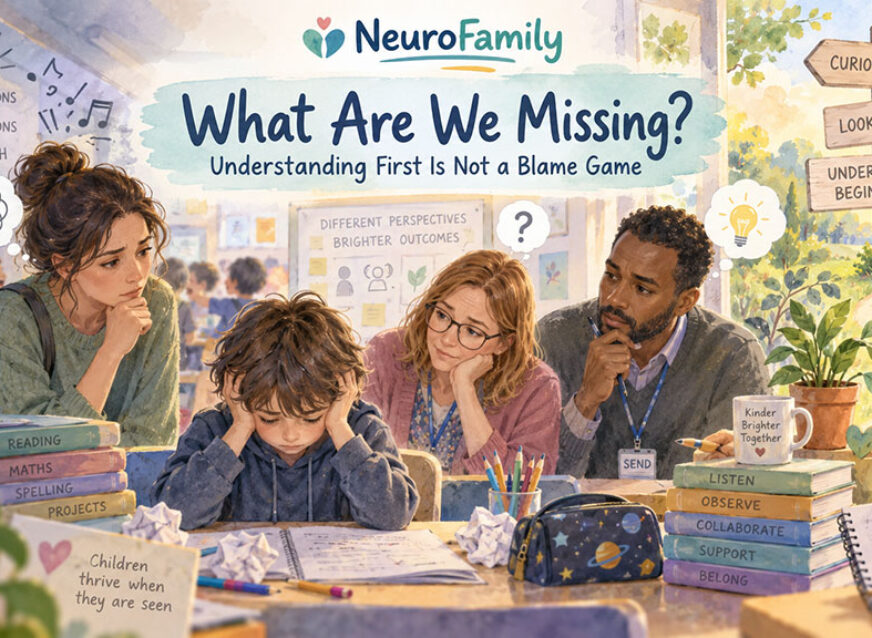
What Are We Missing?
Understanding First Is Not a Blame Game
Over a series of five videos, I’ve been talking about a young person I’m calling Sam.
Sam isn’t his real name, and I’ve changed some of the details because this isn’t about exposing a child, a family, a teacher or a school.
In fact, that’s one of the most important points I want to make.
This isn’t a blame game.
It’s very easy when something isn’t working for a child to start looking for somebody to blame.
The school isn’t doing enough.
The parents aren’t setting boundaries.
The child won’t comply.
The teacher doesn’t understand autism.
The Local Authority isn’t listening.
The child needs to take responsibility.
Sometimes there will be things that organisations or individuals genuinely need to do differently.

Understanding First doesn’t mean avoiding difficult conversations or pretending mistakes haven’t been made.
But if our starting point is:
“Whose fault is this?”
we can become so busy defending our own position that we stop asking the more useful question:
“What are we missing?”
“We’ve tried everything”
Sam’s story began for me with a telephone conversation.
His school was struggling.
There had been adjustments, meetings, conversations and consequences.
A very experienced professional effectively said:
“We’ve tried everything and we don’t know what else to do.”
I didn’t hear an uncaring professional.
I heard somebody who sounded frustrated and genuinely unsure about what to try next.
But there was something in the conversation that concerned me.
The focus had gradually become:
How do we get Sam to do what we need him to do?
And I wondered whether we needed to turn that question around.
“Why is Sam finding it so difficult to do what we’re asking?”
Those questions sound similar.
They aren’t.
One begins with compliance.
The other begins with curiosity.
Understanding doesn’t mean the child is always right
This distinction is important.
Understanding First doesn’t mean:
The child is always right.
It doesn’t mean:
The teacher is wrong.
It doesn’t mean:
Parents know everything.
And it certainly doesn’t mean:
There shouldn’t be boundaries or consequences.

It means that before deciding what needs to happen next, we try to understand what is happening now.
And that means listening to everybody.
The child.
The parent.
The teacher.
The SENDCO.
Other professionals.
Sometimes their accounts will be very different.
That’s okay.
Two people can experience the same interaction very differently without either deliberately misleading us.
Our job shouldn’t immediately be to decide:
“Whose version wins?”
Perhaps the better question is:
“What can we learn from the differences between those experiences?”
Sam was already telling us
During one conversation, Sam said something incredibly important.
In words to this effect:
“If I show you I can do it, you won’t listen when I tell you why I can’t do it another time.”
Think about what he’s telling us.
Adults quite reasonably see:
“You’ve done this before, therefore we know you can do it.”
Sam experiences:
“Because I’ve succeeded before, you don’t believe me when I’m struggling now.”
Neither side necessarily has bad intentions.
They’re looking at the same situation from different starting points.
That’s where we need curiosity.

Because:
Being able to do something and being able to access that ability at a particular moment aren’t always the same thing.
Attention matters.
Processing matters.
Anxiety matters.
Sensory load matters.
Energy matters.
Relationships matter.
What happened five minutes ago matters.
And sometimes what happened five hours ago matters.
“He’s so argumentative”
This was another description I heard repeatedly.
“Sam is so argumentative.”
And I’ve often responded:
“It takes two people to have an argument.”
That’s not about blaming the teacher either.
Teachers are human.
Parents are human.
We all get frustrated.
We all sometimes continue conversations longer than we should.
But when a child and an adult become locked in an argument, we need to ask:
“Who has the greatest capacity right now to change the direction of this interaction?”
Sam may already be angry.
He may feel accused.
He may believe something unfair has happened.
His attention may be completely focused on proving his point.
His capacity to stop may be reducing rapidly.
The adult may still have greater capacity to change direction.
That might mean:
Using fewer words.
Lowering their voice.
Giving processing time.
Stopping the debate.
Saying: “I can see this is important to you. We’ll come back to it when we’re both in a better place to talk.”
That’s not letting Sam win.
Because there doesn’t have to be a winner.
The aim is to stop an interaction becoming a battle.

Understanding has to include the adults too
This is something I feel very strongly about.
We shouldn’t expect endless patience from teachers.
A teacher may have thirty children in front of them.
They may have curriculum pressures.
Other children with significant needs.
Safeguarding responsibilities.
Limited staffing.
Time pressures.
And perhaps their own things happening outside school that nobody knows about.
Understanding First has to apply to them too.
If we’re asking:
“What capacity does Sam have right now?”
we should also be prepared to ask:
“What capacity does this teacher have right now?”
Maybe the teacher knows what would help but cannot realistically provide it alone.
Then simply telling them:
“You need to be more understanding”
isn’t particularly helpful.
Perhaps they need support too.
More information.
A different plan.
Another member of staff.
Permission to handle the situation differently.
Understanding First isn’t about moving blame from the child onto the adult.
It’s about removing blame long enough to understand the problem.
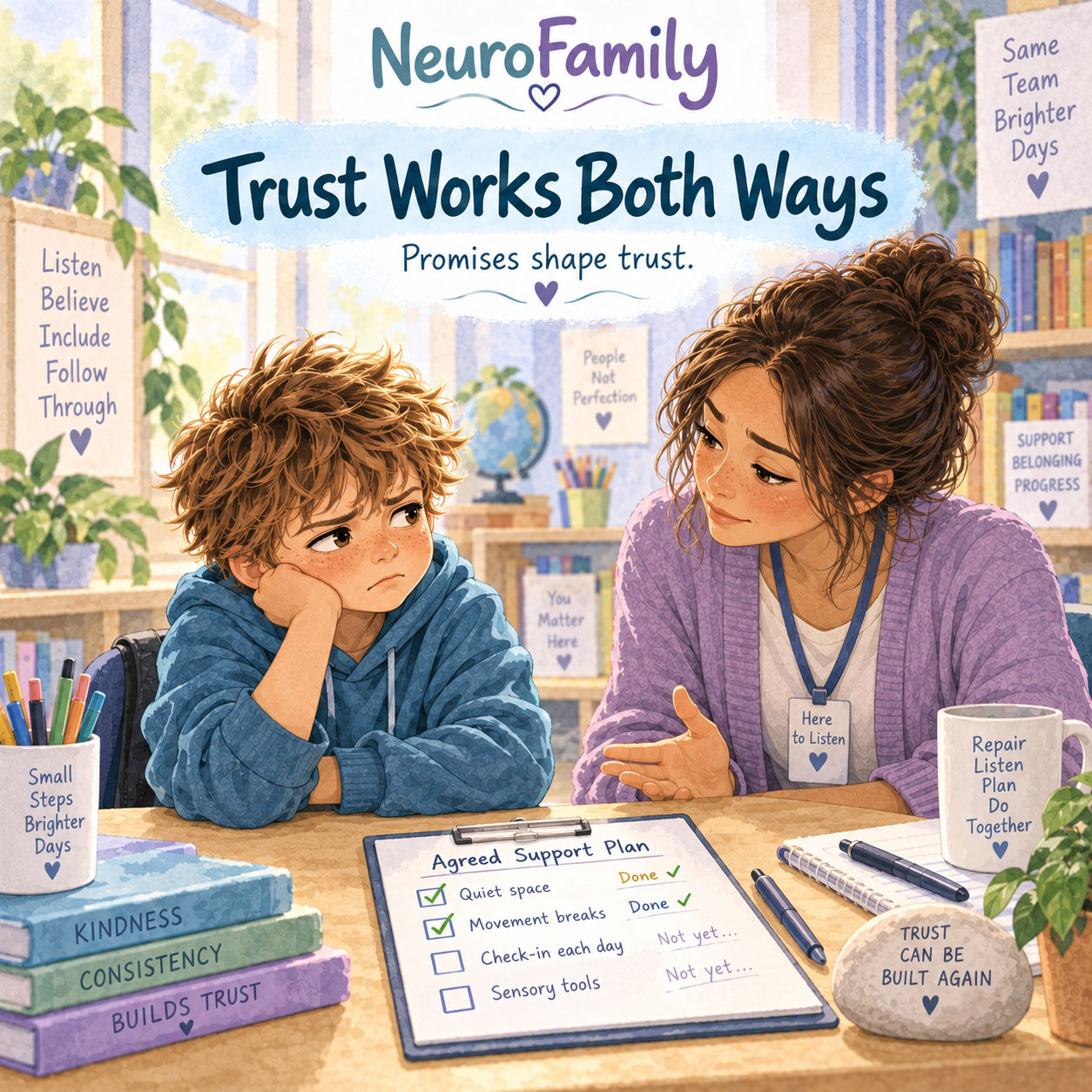
Trust works both ways
Sam also said something else.
Again, in words to this effect:
“You said you were going to put things in place and then you didn’t. So why should I bother?”
Adults may disagree with Sam’s version.
Perhaps something was put in place.
Perhaps he misunderstood what had been agreed.
Perhaps circumstances changed.
But if Sam believes adults haven’t done what they promised, that belief is already affecting the next interaction.
So before saying:
“That’s not true.”
perhaps ask:
“What did you think we’d agreed?”
Validation doesn’t mean agreement.
We can say:
“I can hear that you don’t think we did what we said we’d do. Let’s look at what happened.”
We’re not admitting Sam is factually correct.
We’re showing him that his experience matters enough to investigate.
Trust isn’t rebuilt by winning an argument about who remembers the meeting correctly.
It’s rebuilt through what happens next.
Consequences and learning aren’t automatically the same thing
Sam experienced consequences for his behaviour.
There were serious difficulties.
There were exclusions.
Again, this isn’t about deciding whether every consequence was right or wrong.
Children need boundaries.
Schools need to keep people safe.
Other children matter too.
Staff matter too.
But there is a question we should always ask:
“What did the consequence teach?”
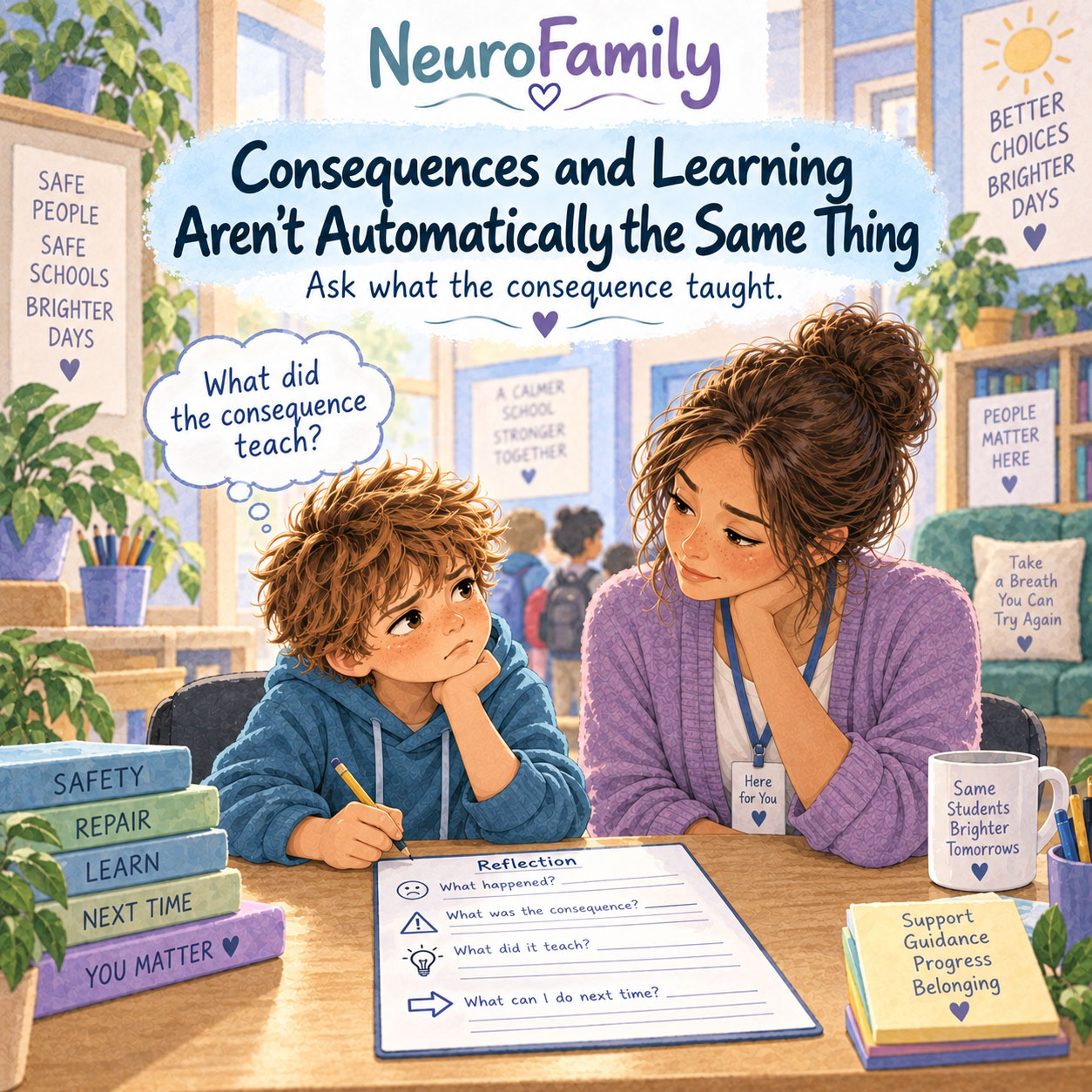
If Sam is excluded, returns to exactly the same circumstances and shortly afterwards the same type of difficulty happens again, perhaps we need to look beyond:
“He hasn’t learned his lesson.”
What was he supposed to learn?
Did we teach him how to recognise overload?
Did we teach another way of communicating?
Did we identify the earlier warning signs?
Did we repair the relationship?
Did adults know what they should do differently?
Did anything about the environment change?
A consequence tells somebody what happens after an event.
Understanding helps us investigate what happened before it.
Restorative work helps everybody decide what they can do next time.
We may need all three.
Don’t start where the behaviour started
Imagine an incident is recorded at 1:45pm.
“Sam was asked to begin his work and refused.”
That may be completely accurate.
But Sam’s difficulty may not have started at 1:45.
Perhaps he slept badly.
The journey to school was difficult.
There was a change when he arrived.

The classroom was noisy.
Something happened with another pupil.
Lunch was difficult.
He thought something was unfair.
He was already using enormous amounts of energy to hold himself together.
Then at 1:45 somebody says:
“Sam, get your book out.”
And Sam says:
“No.”
The adult sees refusal.
But perhaps that final request landed on top of an entire day of accumulated demand.
That’s why one of the biggest messages from these videos is:
Don’t start where the behaviour started.
Start where the difficulty started.
And sometimes we have to look much further back than we initially expect.
But don’t only investigate when things go wrong
This became particularly important in Sam’s story.
Towards the end of the previous academic year, a number of changes had been put in place.
And for a period of time, Sam did significantly better.
That is evidence.
So when difficulties returned after the summer, one of my questions was:
“What was in place when things were working better?”
What’s still happening?
What has stopped?
And if something has stopped:
Why?
There may be a perfectly reasonable reason.
But let’s understand it.
Because sometimes we put support around somebody, they begin doing better, and we conclude:
“They don’t need the support anymore.”
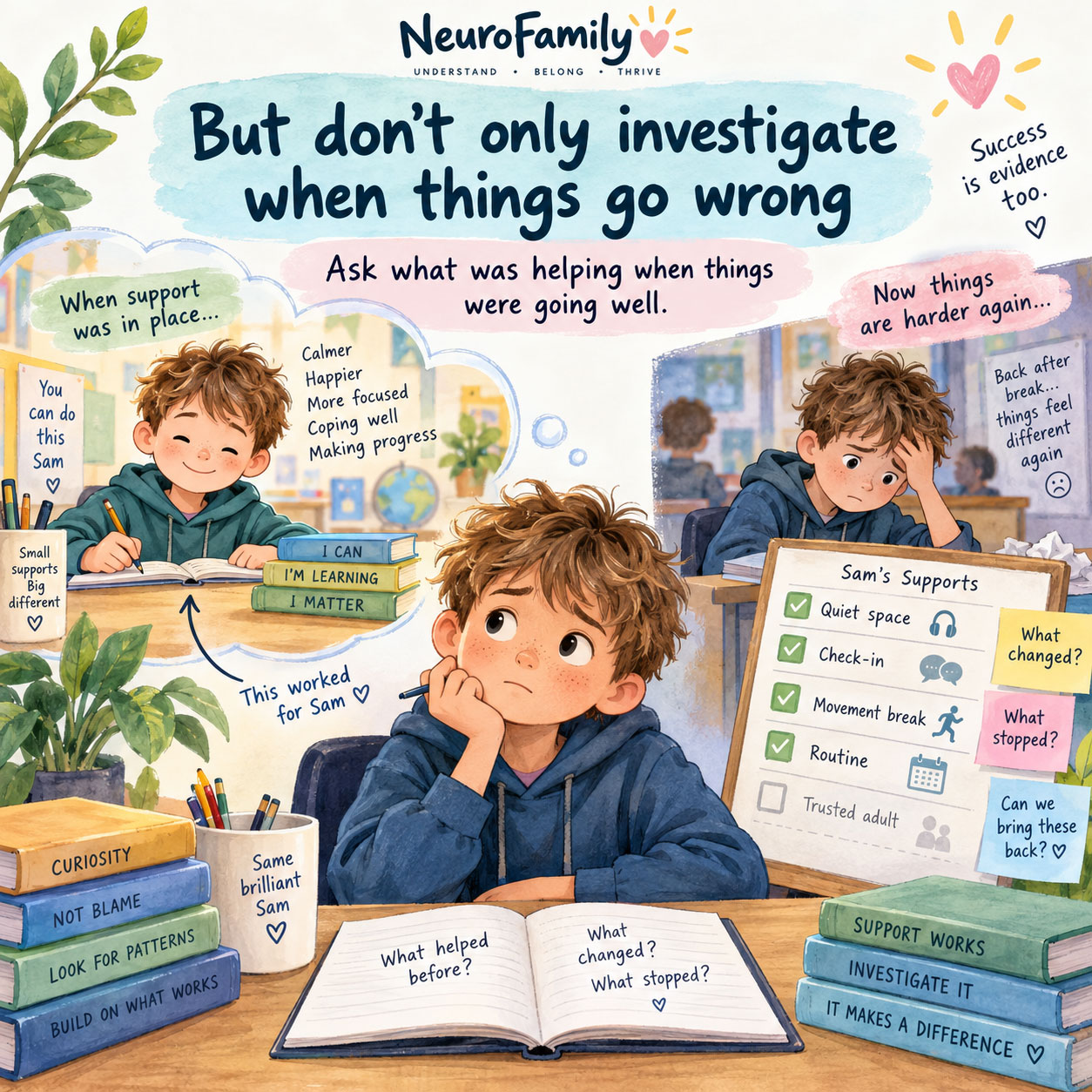
But perhaps they’re doing better precisely because the support is working.
So:
When things go wrong, investigate the difficulty.
When things go well, investigate the success.
Don’t just ask:
“Why did Wednesday go so badly?”
Ask:
“What was different about Tuesday when things went well?”
Success gives us information too.
Everyone has a place in the solution
This, for me, is where we move away from blame.
The child has a place.
What can they learn?
What can they communicate?
What skills can we help them develop?
The parent has a place.
What are they seeing outside school?
What information can they share?
What works at home?
What are they struggling with?
The teacher has a place.
What are they observing?
What is realistically possible in their classroom?
What support do they need?
The SENDCO has a place.
How do we bring the information together?
Are adjustments being implemented consistently?
Are they still appropriate?
The school leadership has a place.
Do staff have the time, training and permission to work differently?
And sometimes the Local Authority or other professionals have a place too.
What resources, assessments or provision are needed?
Nobody needs to carry everything.
But everybody needs to understand:
“What is my part at this moment?”
And that part may change.
Sometimes the child needs to learn something.
Sometimes the adult needs to communicate differently.
Sometimes the environment needs to change.
Sometimes the family needs support.
Sometimes the teacher needs support.
Sometimes the plan needs changing.
Sometimes we simply don’t know yet.
And:
“We don’t know yet”
is a perfectly reasonable place to begin.

Meet people where they are
We often talk about meeting the child where they are.
I think we need to go further.
Meet the parent where they are.
Meet the teacher where they are.
Meet the family where they are.
Meet the professional where they are.
Then ask:
“What does this person need right now to take the next step?”
Not ten steps.
The next one.
Because when everybody is overwhelmed, frightened, defensive or exhausted, demanding more from each other rarely creates better outcomes.
Understanding can.
Understanding First isn’t Accountability Never
There is a phrase I’ve used throughout these conversations:
Understanding First isn’t Accountability Never.
Understanding isn’t an excuse.
It isn’t permission for unsafe behaviour.
It isn’t removing every expectation.
And it isn’t saying that adults must simply tolerate whatever happens.
Accountability still matters.
Repair matters.
Boundaries matter.
Safety matters.
But accountability becomes much more useful when we understand what we’re asking the person to take responsibility for and whether we’ve given them an accessible way of doing something differently.
We can say:
“I understand why you became angry.”
and:
“It’s still not okay to hurt somebody.”
Both can be true.
Then we ask:
“What do we need to do differently next time?”
And that question should apply to everybody involved.
What are we missing?
Perhaps that’s the question that joins all five videos together.
Not:
Who’s to blame?
Not:
Who’s right?
Not:
How do we make the child comply?
But:
“What are we missing?”
What happened before this?
What does the child think happened?
What does the adult think happened?
What does the parent see?
What is the environment contributing?
What is the behaviour doing for the person?
What skills aren’t accessible yet?
What support is working?
What support stopped?
What has changed?
What capacity does everybody have?
What can the child do differently?
What can the adults do differently?
What can the environment do differently?
And what don’t we understand yet?
Because sometimes the answer won’t be another strategy.
Sometimes it won’t be another consequence.
Sometimes it won’t be another professional.
Sometimes the first change is simply everybody becoming curious enough to stop defending their own position and start listening to the others.
That’s not weakness.
It doesn’t remove responsibility.
And it doesn’t guarantee we’ll agree.
It gives us somewhere to start.
Because ultimately this isn’t about finding somebody to blame.
It’s about helping everybody find their place in what needs to happen next.
The child.
The family.
The teacher.
The school.
The professionals.
The wider system.
Different responsibilities.
Different capacities.
Different perspectives.
But hopefully one shared question:
“What can we understand today that helps us do something better tomorrow?”
That’s what Understanding First means to me.
Understanding isn’t the end goal.
It’s where better outcomes begin.
What Are We Missing? Understanding First Is Not a Blame Game by Gordon Forsyth
Tags: ADHD, Attention Deficit, Dyscalculia, Dyslexia, Dyspraxia, Neurodivergent, PAACT Family, Pathological Demand Avoidance Syndrome, PDA, Rejection Sensitivity Disorder, RSD, Selective Mutism, Tips, Trauma Informed Care